
You wrote the draft yourself, yet a scan says it looks machine-generated. Or you are reviewing someone else’s work and wondering whether a suspicious percentage means anything. An AI detector can offer a clue, but understanding that clue matters more than the number.
This guide explains how these systems analyze writing, what their scores mean, and when further review is worthwhile. You will also learn how to handle a disputed result without rewriting good sentences simply to satisfy software.
What Is an AI Detector?
An AI detector analyzes text for patterns associated with machine-generated writing. It produces a prediction about possible AI involvement, sometimes with highlighted passages. It cannot reconstruct the writer’s actual working process from the finished document alone. Grammarly Support
An AI content checker is different from a plagiarism checker. The first evaluates writing patterns; the second looks for matches with material in its source database. Neither automatically establishes misconduct. Properly quoted material can create a similarity match, while newly generated material may match no existing page. Grammarly
Keep three questions separate: Who produced the wording? Are the facts correct? Are sources acknowledged? One score cannot answer all three.
How Does an AI Detector Work?
Training, patterns, and predictions
Many systems use machine learning trained on human writing and generated examples. During AI text detection, a model evaluates features learned from those examples and assigns a classification or score. Vendors use different training material, thresholds, and reporting methods. Grammarly Support
Two commonly discussed signals are perplexity and burstiness. Perplexity measures how predictable wording is to a language model. Burstiness broadly describes variation across passages, including sentence patterns. These signals are useful explanations, but they are not a complete description of every commercial system. Predictable writing is not proof of automated authorship. Grammarly
A ChatGPT detector label also does not establish which particular chatbot produced a passage. Check whether the provider actually supports model identification before treating a general flag as a specific attribution.
Why percentages need a definition
Before interpreting an AI detector result, find out what its percentage measures:
| Report | Meaning of the percentage | Practical interpretation |
|---|---|---|
| GPTZero | The model’s confidence in a document classification | A high AI score does not count the proportion of sentences written by software. GPTZero Support Center |
| Turnitin AI detection | The share of eligible prose flagged as likely AI-generated, including supported forms of later AI modification | The percentage concerns eligible text, rather than the probability that misconduct occurred. Turnitin Guides |
Suppose two reports both display 80%. Those numbers may describe different things. Comparing them without reading the definitions creates false precision.
AI Detector Accuracy: What Can Go Wrong?
Reliability depends on the specific system, text type, sample length, and writing conditions. A headline accuracy claim is difficult to assess without knowing what was tested and which mistakes were counted.
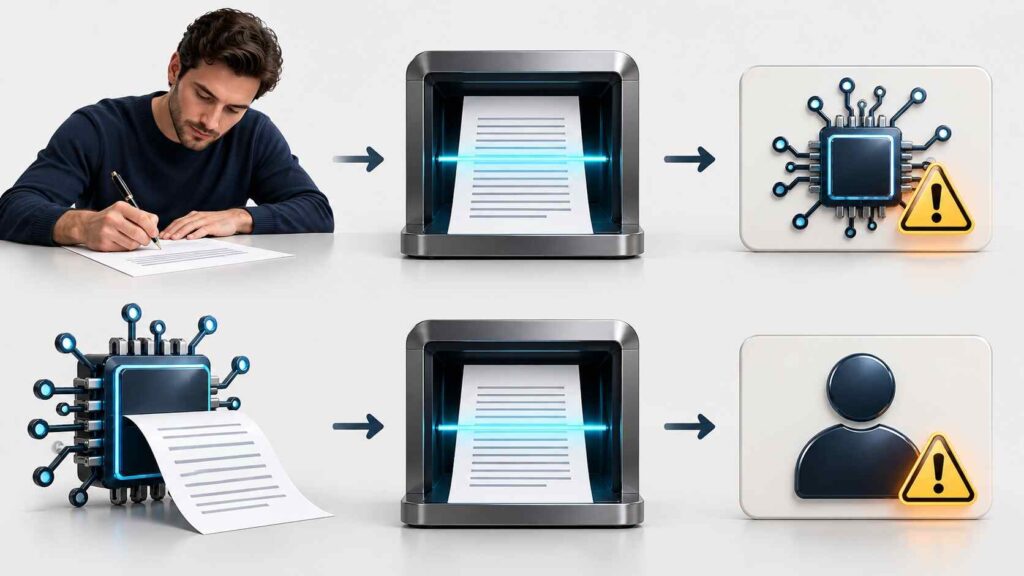
The two main errors are false positives, where human writing is flagged, and false negatives, where generated writing passes unnoticed. A useful evaluation reports both, alongside its test dataset and decision threshold. Grammarly Support
Who and what were tested?
A 2023 Stanford-led study evaluated seven detectors using human-written essays. They frequently misclassified essays by non-native English writers. That finding documents a fairness problem in the systems tested; it is not a current error rate for every product. PMC
Before trusting an AI detector, ask:
- Does its evaluation include writing similar to yours?
- Were recent language models and edited drafts included?
- Are errors reported separately for human and generated samples?
- Was the evaluation independent, and is its methodology available?
For a practical suitability check, collect a small sample of your own original drafts and clearly labeled generated examples. Match their topics and lengths to the documents you normally review. Record incorrect flags as well as missed generated passages, along with the date and software version. This exercise checks local suitability; it does not establish a universal accuracy rate. Revisit the results after a major product update, because the model behind the interface may have changed.
Also consider how often prohibited AI use occurs in the material being reviewed. In a hypothetical batch of 100 documents, assume ten are generated. If software correctly flags eight of those but wrongly flags nine human documents, only eight of its seventeen flags are correct. These are illustrative numbers, not a product benchmark.
That is why a seemingly strong detection rate alone cannot tell you how trustworthy a flag is.
When Should You Trust the Results?
An AI detector is more useful when the text fits its documented requirements, its evaluation matches your situation, and other evidence supports the concern. Treat an unexplained or unsupported result cautiously.
Use it to guide a closer review
An AI writing checker may help an editor decide which submissions need a conversation about sourcing or permitted assistance. It should not replace reading the work.
Suppose a US publisher receives a freelance laptop guide. A high score could prompt questions about how the review was researched. More useful follow-up evidence might include testing notes, original photographs, source records, and explanations of product comparisons.
For a US college assignment, the relevant question is whether the student followed the instructor’s stated rules. A policy allowing brainstorming creates a different situation from one prohibiting generated prose.
Turnitin explicitly advises against using its prediction alone as grounds for action against a student. That guidance matters even when the displayed percentage looks decisive. Turnitin Guides
Look beyond a low score
A low AI detector score does not verify accuracy, original research, or proper attribution. Check quotations, calculations, references, and any claim presented as firsthand experience. A polished article can still contain invented facts.
If you use AI for research or drafting, our Google AI Pro guide explains its writing features, limitations, and privacy controls.
How to Use an AI Detector Responsibly

A useful review follows a consistent process:
- Read the rules first. Establish what assistance the school, client, or publisher allows. Separate permitted editing from prohibited generation.
- Check suitability. Confirm supported languages, document types, and minimum length. Turnitin, for example, requires at least 300 words of qualifying prose for its report. Turnitin Guides
- Protect the document. Review retention, training-use, deletion, and sharing terms before uploading. Use an approved service for confidential work.
- Keep the original. Save the submitted version, scan date, report, and tool version when available. This makes later discussions more precise.
- Read the passages in context. Ask what the writer was explaining and examine the surrounding argument. A highlight identifies something to investigate.
- Review the writing process. Discuss outlines, notes, sources, and available revision history. Missing history alone does not establish wrongdoing.
If your own work is flagged, request the full report and an explanation of the applicable policy. Share relevant evidence and explain how you developed the argument. Revision history can support that account, although it is not conclusive proof.
Avoid repeatedly changing accurate wording just to lower an AI detector score. Improve unclear explanations, verify sources, and disclose assistance where required.
Frequently Asked Questions
Can a free AI detector be trusted?
A free service can provide an initial signal, but price does not establish reliability. Check its validation evidence, privacy terms, and sample requirements. Evaluate paid services using the same criteria.
Can human writing be flagged as generated?
Yes. Human language can share patterns that a detection model associates with generated text. A disputed flag deserves contextual review, especially before a decision affecting grades, payment, or reputation. PMC
Does a 100% score prove cheating?
No. First check what the percentage represents. Then review the assignment rules and supporting evidence. A software classification does not establish whether a particular use was permitted. Turnitin Guides
Will another scan settle a disagreement?
Not necessarily. Different services can disagree, and matching results do not establish that their errors are independent. Additional evidence about the work’s creation is usually more useful than collecting scores. Grammarly Support
Conclusion: Check the Evidence Behind the Score
An AI detector can help identify writing that deserves closer attention. Its value depends on suitable input, clearly defined scores, and careful follow-up.
Before acting on a result, read the provider’s documentation and examine the writer’s process. Start by preserving drafts and verifying sources: those steps improve accountability whatever the software predicts.
