
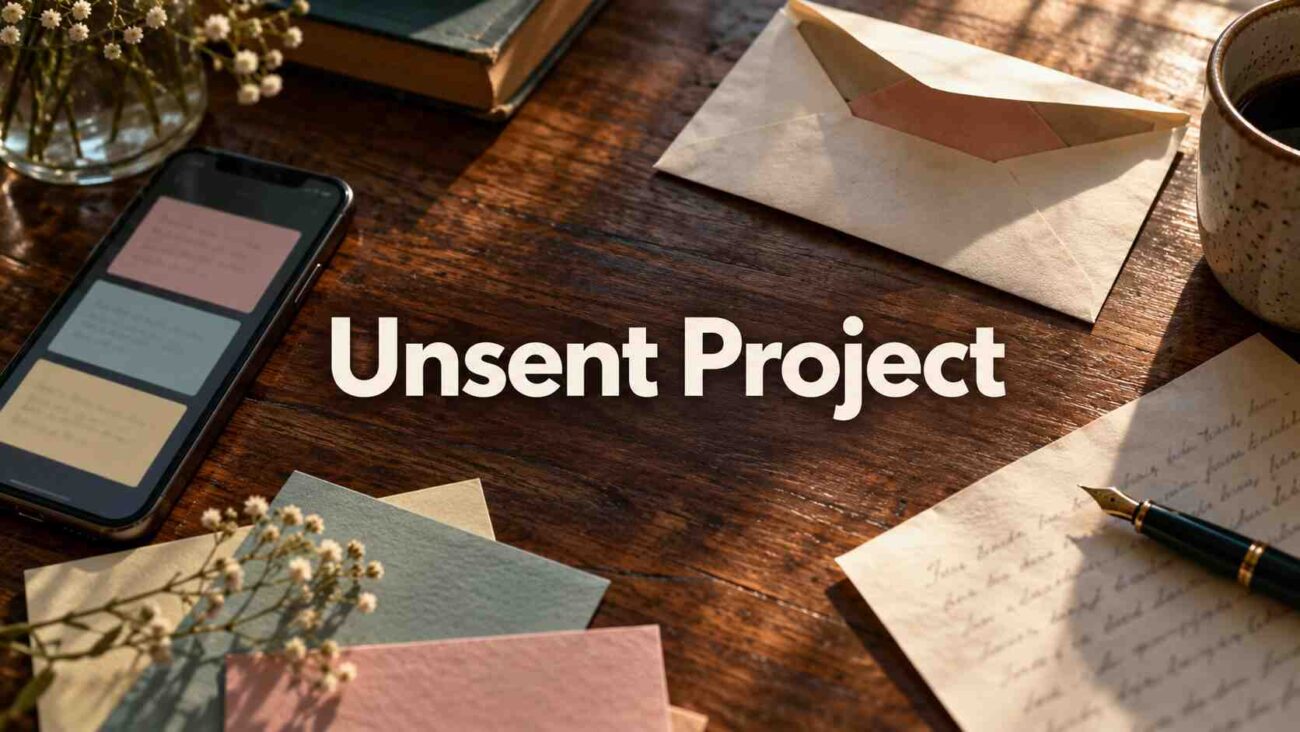
Finding a heartfelt message carrying your name can feel deeply personal. The Unsent Project makes that moment possible, but understanding what you are reading matters. A matching name does not establish who wrote a message or whom it concerns. This guide explains how the Unsent Project works, how to explore it thoughtfully, and what to consider before contributing. The Unsent Project can offer a place for expression when you understand its boundaries.
- What is the Unsent Project?
- Unsent Project Search: Find Names Without Misreading Results
- Why Unsent Project Messages Cannot Identify Their Authors
- Unsent Project Submissions: Share a Message Thoughtfully
- What Unsent Project Colors Actually Mean
- Unsent Project Privacy: What Anonymous Posting Really Means
- Choose the Right Place for Your Words
- A Documented Reader Experience and Its Limits
- Why Your Submission Might Not Appear
- Frequently Asked Questions
- Conclusion: Read With Empathy, Share With Intention
What is the Unsent Project?
The Unsent Project is an art initiative collecting unsent text messages addressed to first loves. Artist Rora Blue started it in 2015 to explore the colors people associate with love. Contributors submit anonymous text messages, which appear against their chosen backgrounds.
The official About page reports more than eleven million submissions. That figure should not be confused with the number currently published and searchable.
The Unsent Project interprets first love broadly, including friendships, relatives, and pets. Think of the Unsent Project as a shared collection of feelings rather than a service delivering messages.
Unsent Project Search: Find Names Without Misreading Results
Start at the official archive, where the Unsent Project provides a field labeled “Search for a name.” Enter a first name and run the search.
For a useful search by name, try this approach:
- Begin with the spelling the person normally uses.
- Try a familiar nickname separately if relevant.
- Read several results before interpreting any single message.
- Keep emotional recognition separate from identifying evidence.
Suppose your name is Alex. An Unsent Project message mentioning regret might resemble an old relationship. Many other people could recognize the same situation.
Searching the Unsent Project helps you discover writing addressed to a name; it cannot establish a personal connection. If nothing appears, that also tells you little about someone else’s feelings.
Why Unsent Project Messages Cannot Identify Their Authors
The Unsent Project invites readers into intimate stories without supplying reliable identity checks. This creates an understandable temptation: filling missing details with your own memories.
A sentence about an unanswered call may sound specific until you consider how common that experience is. Likewise, unsent letters can describe emotions shared across thousands of relationships.
Use the Unsent Project for reflection rather than investigating an ex. Before acting on a result, ask yourself whether you would interpret it the same way without seeing the name.
The strongest reading habit is curiosity without certainty. A powerful Unsent Project entry can matter to you even when its author remains unknown.
Unsent Project Submissions: Share a Message Thoughtfully

The submission form asks for a recipient’s first name and agreement to the submission terms. The site’s instructions also explain choosing a background color.
Before using the Unsent Project, draft your message elsewhere. Read it again after the initial emotion settles. Good first love messages express something meaningful without requiring strangers to reconstruct a relationship.
For instance, one could craft a message such as: “I wish I thanked you when it was hard to be kind.” Note that this is made up and not a customer testimony.
Before publishing, ask yourself three questions: Would I feel comfortable if a friend read this? Am I expressing something, or trying to provoke a response? Would waiting until tomorrow change what I want to say? These questions help separate a feeling from an impulse.
You can also save two drafts: one containing everything you need to say, and another suitable for public reading. The first gives you space to be specific. The second lets you decide which details actually help someone understand the emotion without exposing a shared history.
A thoughtful Unsent Project contribution focuses on what you want to express. It does not need a dramatic revelation. Ask whether you would still value writing it if the intended person never discovered it.
What Unsent Project Colors Actually Mean
The Unsent Project began with a question about the color of love. According to Rora Blue’s project description, contributors select colors associated with their first love.
That makes color meanings personal. A blue background might suggest sadness to one reader and comfort to another. Avoid treating colors as a universal decoding system.
When you look at the Unsent Project, take into account color along with words. When submitting, choose what feels appropriate to your experience. Your choice does not need to match somebody else’s interpretation.
Unsent Project Privacy: What Anonymous Posting Really Means

The Unsent Project is public expression. Its terms say submissions may remain searchable indefinitely and offer no way for contributors to delete them. Users must be eighteen or older.
The policy also describes collecting technical information, including IP addresses. Therefore, online privacy deserves attention even when a name is absent.
For the Unsent Project, remove identifying details before submitting. Its rules prohibit surnames, usernames, addresses, phone numbers, dates, and other identifying information. Writing anonymous love letters responsibly means protecting the other person as carefully as yourself.
Choose the Right Place for Your Words
Before opening the Unsent Project submission page, decide what outcome you want.
| Your goal | Better approach | Reason |
|---|---|---|
| Read shared experiences | Browse the archive | Discover different perspectives |
| Express something publicly | Consider submitting | Accept public visibility |
| Keep full personal details | Use private journaling | Control access yourself |
| Resolve a misunderstanding | Consider direct conversation | Allow clarification and response |
These choices serve different needs. The Unsent Project may suit public reflection, while a personal draft gives you more room to reconsider.
A Documented Reader Experience and Its Limits
In August 2026, The Washington Post reported that reader Andrew Chan found emotionally resonant Unsent Project messages after searching his name.
That experience illustrates an important distinction for readers: feeling understood does not establish who intended a message for whom. Your response to writing can be meaningful without turning it into evidence.
Approach the Unsent Project with that distinction in mind. Notice what a message brings up for you, then decide whether continued browsing feels useful.
Also Read: What Is Zvodeps? Meaning and Key Facts Explained
Why Your Submission Might Not Appear
The Unsent Project uses message moderation rather than instant publication. Its terms do not guarantee review or posting, limit submissions to one every twenty four hours, and require English.
If your contribution is missing, avoid inventing a technical explanation. The Unsent Project does not promise a publication deadline. Purchases do not influence approval, according to its terms.
For loading problems, try refreshing or another browser before assuming a wider outage. Avoid repeatedly reposting the same text. The Unsent Project rules also reject duplicates.
Frequently Asked Questions
1. Is the Unsent Project real?
Yes. Rora Blue’s website links to the official Unsent Project domain. However, the existence of the platform does not verify every story submitted to it.
2. Can I find messages intended for me?
You can search the Unsent Project using your name. A matching result does not confirm that you are its intended recipient.
3. Can I discover who submitted a message?
The Unsent Project describes submissions as anonymous. Treat claims that a search result identifies a particular sender with skepticism unless independent evidence supports them.
4. Can I delete something after submitting?
The Unsent Project submission terms state that contributors cannot delete submissions. Read those terms before publishing anything you might later want removed.
5. Are all submissions published?
No. The Unsent Project terms explicitly say review and publication are not guaranteed. Check the current rules rather than relying on promised approval times.
Conclusion: Read With Empathy, Share With Intention
The Unsent Project offers a compelling way to encounter feelings people struggled to express. Its value comes from recognition, reflection, and the courage behind a carefully chosen sentence. Search names with perspective. Treat anonymity thoughtfully. Before submitting, consider whether public sharing serves your purpose. Use the Unsent Project to understand an emotion rather than settle an uncertainty about another person.
