

If you’re comparing test.com pricing enterprise plans, here’s the practical answer: Gauge advertises Enterprise software from $10,000 annually, plus $1,000 hosting and $2,000 setup. Those starting components total $13,000 for the first year, but that isn’t a guaranteed quotation for your program.
The investment deserves attention when exams support your certification business. For occasional quizzes, however, buying Enterprise needs a much stronger justification. Let’s separate the published facts from the questions your purchasing team still needs answered.
- Executive Summary: Plan Comparison at a Glance
- Understand the Product Before Comparing Prices
- What Do the Published Plans Cost?
- Why Exam Volume Changes the Budget
- What Useful Capabilities Are Listed?
- Technical Checks That Matter Before Signing
- When Is Enterprise Worth Paying For?
- Conclusion
- Frequently Asked Questions
Executive Summary: Plan Comparison at a Glance
| Pricing Component | Professional Plan | Enterprise Plan |
| Target Volume | Up to 10,000 exams/year | 10,000+ exams/year |
| Software Base | From $750 / year | From $10,000 / year |
| Annual Hosting | $250 / year | $1,000 / year |
| One-Time Setup Fee | $500 | $2,000 |
| First-Year Budget | ~$1,500 | ~$13,000 |
| Recurring Annual Cost | ~$1,000 / year | ~$11,000 / year |
Understand the Product Before Comparing Prices
Gauge is operated by Test.com, Inc., as its published terms explain. Meanwhile, the Test.com domain currently displays a marketplace listing for domain domain acquisition—a completely separate commercial transaction from purchasing testing software. This review concerns Gauge software, not purchasing that web address.
As enterprise testing software, Gauge combines examinations with certification management. You can build assessments, control delivery settings, and connect results with credentials. The discussion below draws on published documentation, not firsthand product testing.
What Do the Published Plans Cost?
Understanding test.com pricing enterprise plans starts with separating software, hosting, and setup rather than treating the advertised subscription as your entire budget.
Professional: A Smaller Starting Commitment
Professional begins at $750 annually, with $250 hosting and a $500 initial setup charge. Adding those published components gives $1,500 for year one and $1,000 for recurring software and hosting before additional requirements. Gauge describes eight usage tiers and a modular approach, letting growing programs select needed capabilities.
Enterprise: Built Around Larger Programs
Enterprise targets organizations delivering more than 10,000 tests yearly. Its advertised components produce the $13,000 starting calculation above. Removing the initial setup charge leaves $11,000 in annual software and hosting at those same starting figures. Neither calculation establishes what your particular contract will cost.
Procurement Note:
“Gauge Enterprise has a documented starting baseline of $10,000/year software + $1,000/year hosting + $2,000 setup, based on final volume and module requirements.”
Why Exam Volume Changes the Budget

Gauge bases pricing on annual exam volume. Its Enterprise guidance describes volume pricing starting at $3 per test, decreasing as usage grows. The pricing page says its largest customers pay considerably below $1 per test.
Crucially, the public page doesn’t clearly reconcile that usage model with the advertised annual starting components. Don’t automatically add both together, or assume one replaces the other. Ask Gauge to explain the applicable structure in writing.
When assessing test.com pricing enterprise plans, establish what counts as a chargeable attempt, how retakes affect usage, and what happens above your agreed allowance. These are purchasing questions, not confirmed extra charges.
Separate your expected yearly total from peak demand. Ten thousand attempts spread across twelve months and a concentrated examination event create different operational questions. Provide both figures, and request evidence that the proposed configuration supports your busiest scheduled session.
What Useful Capabilities Are Listed?
Enterprise lists certificates and badging, lessons, ecommerce, developer tools, and proctoring integration. Together, these support more than displaying questions: they connect assessment with learning, credential management, and commercial administration.
The testing product also supports reusable question banks, randomized delivery, configurable timing, attempt limits, and different question formats. Those controls let administrators design exams around their program instead of accepting identical settings everywhere.
There is an important budget distinction: online proctoring isn’t automatically free because the connection is available. Gauge says supervision is priced per session and incorporated into your quote. Request costs for your chosen supervision arrangements separately.
During the demonstration, follow one candidate from enrollment through assessment and credential issuance. Check the administrator’s view as well as the candidate’s screen. A feature earns its place in your budget when it removes a specific handoff, not merely because it appears on a comparison chart.
Technical Checks That Matter Before Signing
Integrations Should Prove Their Practical Value
For technology teams evaluating test.com pricing enterprise plans, the integration details matter. Gauge offers REST API, webhooks, and single sign-on (SSO) capability to integrate with existing systems.
In simple terms, the API lets applications exchange information, webhooks send event notifications, and shared authentication reduces separate logins. Ask developers to demonstrate candidate registration and result transfer using your actual systems.
Then examine authentication requirements, request limits, failed delivery handling, duplicate event protection, and responsibility for maintenance. These are validation criteria, not promises about undocumented functionality. Access to developer tools doesn’t establish that every custom connection is already built.
Security Needs Evidence, Not Adjectives
Gauge describes granular permissions, IP restrictions, authentication controls, and exportable audit histories. It also offers hosting, backup, recovery, and incident response documentation for security review.
Have your security team check those materials against your requirements. Define who may edit exams, inspect candidate records, or change access settings. Request written service commitments rather than interpreting marketing language as an independently audited compliance guarantee.
Also agree on the incident escalation process during a scheduled examination. Ask how interrupted attempts are handled, who authorizes restarts, and how changes appear in the activity history. Document the answer in the implementation checklist.
When Is Enterprise Worth Paying For?
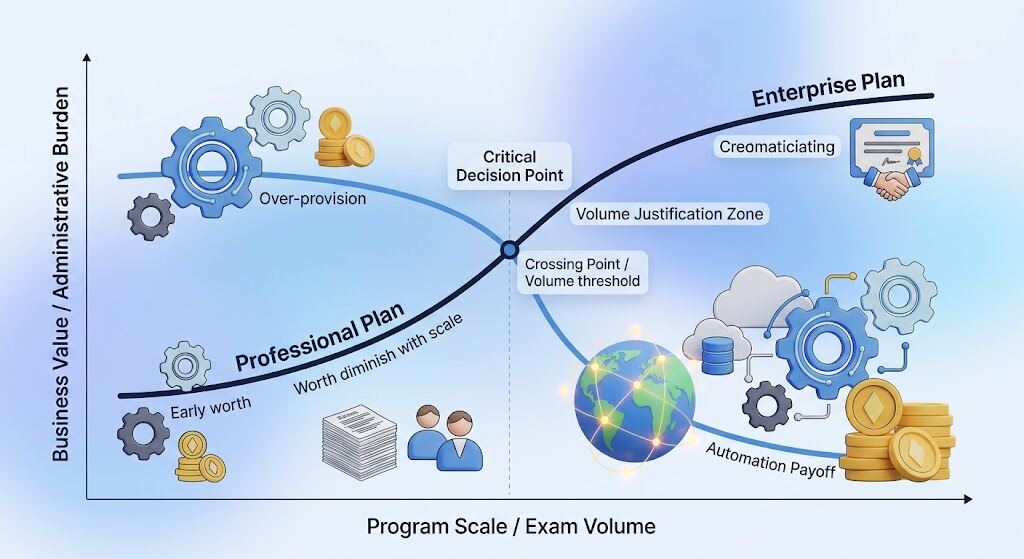
The strongest case for test.com pricing enterprise plans is a demonstrated operational improvement, not the Enterprise label. A program handling substantial assessment activity should evaluate whether connected records and automated workflows reduce its actual administrative burden.
Build your comparison around equivalent requirements. Include the quoted platform agreement, supervision, internal engineering, training, and ongoing administration. Ask what the setup charge covers and which responsibilities remain with your team.
Measure staff time spent managing candidates today, then repeat representative tasks during a demonstration. Count savings only when observed. Also evaluate candidate completion, support needs, and reconciliation errors rather than relying entirely on subscription price.
For smaller programs, price Professional with the necessary modules before upgrading. Enterprise becomes more persuasive when its quoted economics and demonstrated controls match requirements that a simpler configuration cannot satisfy.
Make the Proposal Comparable
Ask each shortlisted vendor to price the same expected activity and required outcomes. Separate fixed commitments from usage charges, and document the conditions supporting the offer. This makes differences visible without inventing a universal market rate. A higher quote can be reasonable, but only the documented scope and your evaluation results can establish value. That discipline protects your budget while keeping procurement focused.
Conclusion
Ultimately, test.com pricing enterprise plans merit consideration for demanding certification operations, especially above the vendor’s stated testing threshold. The published starting fees help frame a budget, but usage and supervision require explicit clarification. Request an itemized proposal and a realistic demonstration. Buy the operational outcome you can verify, not an attractive headline or an assumed saving.
Frequently Asked Questions
Can We Evaluate Gauge Without Providing Payment Details?
Yes. Gauge advertises a free evaluation lasting 30 days without requiring a credit card. Ask which workflows your evaluation environment will support.
Can Existing Examination Records Be Imported?
Gauge says existing items, candidate records, and credential history can be imported. Confirm field mapping and validate a representative sample before approving the transfer.
Does Gauge Support International Candidates?
The vendor lists availability in 26 languages. Confirm your required language and review candidate screens before committing to an international rollout.
Who Owns Information Submitted by Candidates?
The published terms assign ownership of submitted information and test responses to the client organization. Review the applicable agreement and privacy provisions for your deployment.
Does Gauge Replace a Psychometrician?
No. Gauge provides assessment reports and item data, while equating, standard setting, and specialized modeling remain with your psychometrician or analysis service.
