
A password-reset link looks like a harmless jumble of letters—until someone guesses it. That is why choosing a random character generator is more than a convenience decision. Developers need unpredictable output, but users also need confidence that their secrets will not leak through logs, caches, or an unnecessary third-party service. The real test is not whether a string looks complicated. It is whether the entire generation process deserves trust.
- What Is a Random Character Generator?
- Unpredictability Beats Strings That Merely Look Random
- Match the Output to What It Protects
- Build a Random Character Generator Without Reinventing Crypto
- Protect the Endpoint—and Keep Secrets Close
- A Documented Production Lesson: Cloudflare’s LavaRand
- FAQs
- Conclusion: Trust the Process, Not the Appearance
What Is a Random Character Generator?
A random character generator selects symbols from a defined alphabet: letters, digits, punctuation, or a combination. It can return one random character or assemble a longer string.
A random letter generator can answer “give me a random character” with Q. A random string generator creates longer values for testing or credentials. A random fictional character generator does something different: it invents story personalities, not security tokens.
Unpredictability Beats Strings That Merely Look Random
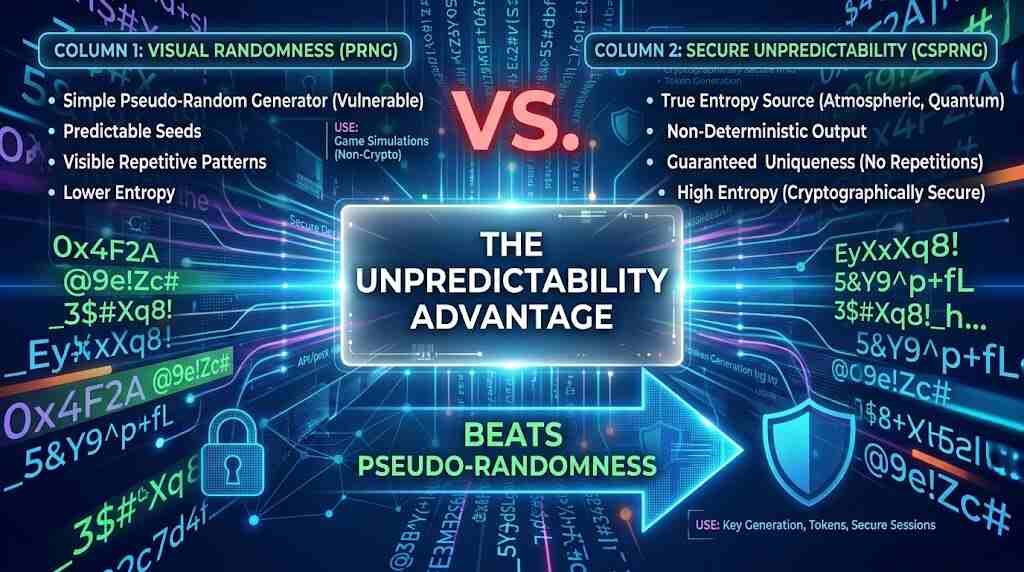
A secure random character generator uses a cryptographically secure pseudorandom number generator, or CSPRNG. OWASP warns against ordinary randomness functions for security-sensitive uses and identifies Node.js Math.random() as unsuitable.
Alphabet selection matters, too. Simply calculating randomByte % alphabet.length can favor some symbols. Node.js documents that crypto.randomInt() avoids this modulo bias. For custom alphabets, that is a better starting point than improvised character selection.
A random number generator is therefore only part of the decision: its cryptographic properties and the conversion into characters both matter.
Match the Output to What It Protects
Evaluate a random character generator against its actual job—not its marketing claims.
| Use case | Suitable approach | Essential safeguard |
|---|---|---|
| Letter games | One randomly selected letter | No security claims |
| Test fixtures | Dummy strings | Never reuse as live credentials |
| Password resets | Long CSPRNG-generated tokens | Expiry and single use |
| API credentials | High-entropy secrets | Restricted access and revocation |
For password resets, OWASP recommends cryptographically generated, sufficiently long tokens that are stored securely, used once, and expired appropriately. A secure password generator cannot replace those lifecycle controls.
Build a Random Character Generator Without Reinventing Crypto
For a Node.js random character generator, the generation core can be straightforward:
import { randomBytes } from 'node:crypto';

const token = randomBytes(32).toString('hex');
This random string generator converts 32 cryptographically generated bytes into 64 hexadecimal characters. Encoding makes the bytes printable; it does not create additional entropy.
For example, an API call would be POST /v1/random-characters with {“bytes”:32,”encoding”:”hex”}. Explicitly distinguish byte count from output character count, validate both parameters, and cap request sizes.
For identifiers that must be unique, add a database uniqueness constraint and retry collisions. Randomness alone does not guarantee uniqueness. If cryptographic generation fails, return an error rather than falling back to weaker randomness.
Protect the Endpoint—and Keep Secrets Close

A random character generator API should use HTTPS, authorize access to protected endpoints, limit abusive requests, and keep credentials out of URLs. Set Cache-Control: no-store for secret-bearing responses, but remember that application-managed caches need separate controls.
Generated secrets should not be captured in analytics or logging. Where possible, generate sensitive tokens inside the application that consumes them. Outsourcing generation adds another party that can potentially observe the secret.
Testing output length and allowed symbols catches implementation mistakes. It does not prove unpredictability; a predictable generator can still produce convincing-looking strings.
A Documented Production Lesson: Cloudflare’s LavaRand
In an engineering account published on @March 8, 2024, Cloudflare describes mixing physical entropy, previous seed material, and local system randomness before feeding a CSPRNG. Its LavaRand system exposes randomness through an internal API.
The useful lesson for a random character generator is not “buy lava lamps.” It is to understand the source, transformation, and delivery of randomness. This is a documented infrastructure example, not an invented customer testimonial or an endorsement of an unnamed commercial API.
FAQs
1. Is every random character generator secure?
No. Check whether the underlying random number generator is cryptographic, how symbols are selected, and how generated secrets are handled.
2. Can it give me a random character?
Yes. A random letter generator can select one letter; that is useful for games, not authentication.
3. How long should a security token be?
Choose an entropy target and threat model, not an arbitrary character minimum. The example above begins with 256 bits of random data.
4. Can it work as a secure password generator?
Yes, if generation is cryptographic and the result fits the application’s password rules. Use a password manager to store unique passwords.
5. Is this a random fictional character generator?
No. Fictional-character tools create personalities and backstories; developer-focused generators create symbols or strings.
Conclusion: Trust the Process, Not the Appearance
A trustworthy random character generator does more than produce an impressive-looking string. It uses established cryptographic functions, avoids biased selection, and protects secrets throughout their lifecycle. Build locally when practical, expose only necessary API capabilities, and verify the implementation behind security claims. For users, the payoff is simple: fewer opportunities for someone else to turn a supposedly random token into access to their account.
