
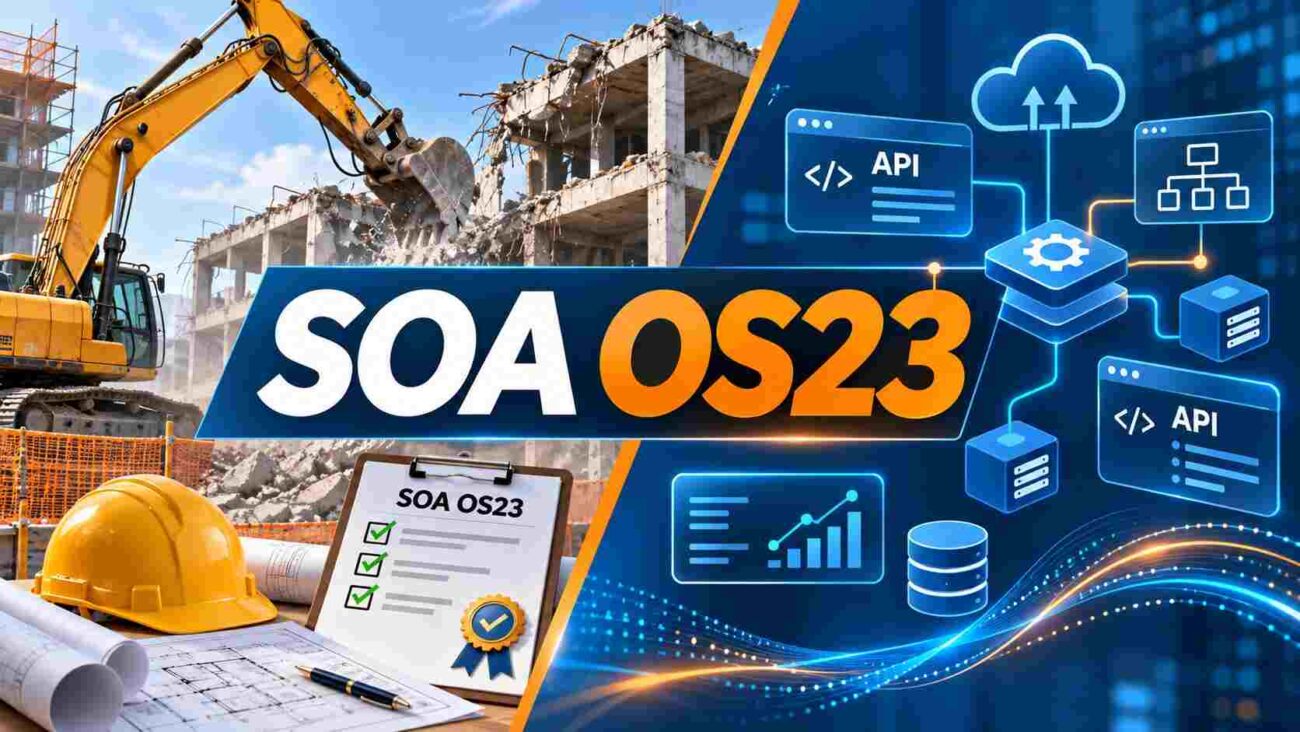
Search for SOA OS23, and you may encounter two very different explanations. Some websites describe an advanced software framework involving APIs, microservices, and automation. Others identify SOA OS23 as an Italian qualification for specialist demolition contractors.
The distinction matters because one interpretation is supported by public procurement regulations, while the claimed software standard lacks an independently verified specification.
SOA OS23 has a documented meaning in Italian construction certification. The software interpretation should be treated as an unverified claim rather than an established industry standard.
This guide examines both meanings, explains the actual certification requirements, and shows readers how to verify the information themselves.
What Is SOA OS23? The Verified Meaning
SOA OS23 refers to a qualification category for demolition works under Italy’s public procurement system.
In this context, SOA refers to Società Organismo di Attestazione, an authorized certification body that evaluates whether businesses satisfy prescribed requirements for public construction contracts.
OS23 identifies a specialized category called Demolizione di opere, meaning demolition of works.
The category appears in Table A of Annex II.12 to Italy’s Legislative Decree 36/2023.
It concerns activities such as dismantling industrial facilities, demolishing buildings, cutting reinforced concrete, and handling resulting materials.
The qualification is relevant when contractors need to establish their eligibility for particular public construction projects.
It is not an operating system, downloadable software product, or programming framework.
What Types of Construction Work Does OS23 Cover?
The Italian classification describes more than ordinary building removal. It encompasses specialist activities requiring suitable equipment, organizational capacity, and technical expertise.
Typical work covered by the definition includes:
- Complete building demolition using specialized machinery.
- Dismantling industrial installations and structures.
- Cutting reinforced-concrete components.
- Demolition involving explosives where separately authorized.
- Collecting, sorting, and potentially recycling demolition materials.
The scope makes OS23 relevant to demolition contractors bidding for appropriately classified public works.
A Practical Construction Example
Imagine a municipality commissioning the removal of an abandoned industrial building.
The project may involve dismantling machinery, separating steel from concrete, and managing demolition debris.
A contractor considering the tender should examine whether OS23 appears among the specified work categories and whether its qualification covers the required contract value.
However, holding an SOA certificate does not automatically satisfy every construction safety, environmental, waste-management, or project-specific requirement.
Those obligations must be assessed separately.
How SOA OS23 Certification Works

Italy uses SOA attestations to demonstrate specified technical, organizational, and financial qualifications for public construction contracts.
Under Article 100 and Annex II.12 of Legislative Decree 36/2023, the SOA system generally applies to public works contracts valued at €150,000 or more.
A business pursuing construction certification must demonstrate the requirements appropriate to its requested category and financial classification.
Qualification Classes and Contract Values
The amount a company can qualify for depends on its attested class.
| SOA class | Base qualification ceiling |
|---|---|
| Class I | €258,000 |
| Class II | €516,000 |
| Class III | €1,033,000 |
| Class III-bis | €1,500,000 |
| Class IV | €2,582,000 |
These are statutory classification ceilings, not certification fees.
Annex II.12 also provides a possible one-fifth increase to qualification limits, subject to applicable conditions. Additional classes cover larger projects.
What Must a Contractor Demonstrate?
The assessment can involve:
- Documented experience performing qualifying works.
- Appropriate financial and economic capacity.
- Technical management and organizational resources.
- Suitable equipment and qualified personnel.
- Compliance with applicable legal eligibility requirements.
Larger classifications may also require a qualifying company quality-management system. This requirement is distinct from automatically possessing ISO 9001 certification in every situation.
An SOA attestation ordinarily operates on a five-year cycle, subject to a mandatory three-year verification of continuing requirements.
For public procurement participation, contractors should confirm the certificate remains effective and matches the tender’s specified category and class.
How to Verify an SOA OS23 Certificate
A contractor’s claim of certification should be checked through an authoritative source rather than accepted from a brochure or website badge.
Italy’s National Anti-Corruption Authority, ANAC, provides an official SOA attestation search service.
Practical Verification Steps
- Open ANAC’s official attestation search website.
- Search using the company’s identification information and available filters.
- Confirm that the displayed qualification includes OS23.
- Examine the financial classification and certification status.
- Check the relevant validity and intermediate verification dates.
- Compare the certificate details against the actual tender requirements.
ANAC’s published data also distinguishes active attestations from expired, invalidated, and revoked certificates.
For example, a certificate showing OS23 Class I should not be presented as unrestricted qualification for every demolition contract.
For a definitive assessment of construction bidding eligibility, consult the contracting authority or a qualified Italian public procurement professional.
This procedure is based on published verification resources, not a claimed inspection of a particular contractor’s records.
Is SOA OS23 a Software Standard?
Some technology articles describe SOA OS23 as “Service-Oriented Architecture Open Standard 2023.”
However, no authoritative specification establishing that exact name was found in the standards materials reviewed.
The distinction is important because service-oriented architecture is a recognized concept in software engineering, but recognition of SOA does not establish an official OS23 software standard.
What Is Genuine Service-Oriented Architecture?
In software architecture, SOA organizes capabilities as services that can communicate through defined interfaces.
The OASIS organization published its official Reference Model for Service Oriented Architecture 1.0 on October 12, 2006.
That document explains principles relevant to distributed systems and service interactions.
Contemporary implementations may employ:
- API integration between business applications.
- Microservices architecture for independently managed capabilities.
- Cloud computing infrastructure for service deployment.
- Kubernetes for container orchestration.
- Monitoring, authentication, and automated delivery tools.
For a practical example of how established cloud technologies are managed, explore our AWS Console guide, which explains cloud infrastructure, service configuration, and resource monitoring.
These are established technologies, but they are not evidence of a standardized product named SOA OS23.
Before adopting terminology in technical documentation, ask for the standard’s publisher, version history, specification, and implementation guidance.
Without those details, a claimed open standard should remain unverified.
SOA OS23 vs. Software SOA: Key Differences

The simplest way to understand the confusion is to compare the two interpretations.
| Question | Italian SOA OS23 | Software-related claims |
|---|---|---|
| Main field | Construction | Information technology |
| Purpose | Contractor qualification | Claimed software architecture |
| Official documentation | Italian procurement legislation | No verified OS23 specification found |
| Related activities | Demolition and dismantling | APIs, services, automation |
| Verification | ANAC certification records | Request an authoritative technical specification |
The shared letters “SOA” do not establish a relationship between the two fields.
For business decision-makers, this difference prevents confusion when researching enterprise architecture, technical standards, or contractor qualifications.
It also offers a practical lesson: a frequently repeated explanation is not necessarily supported by an authoritative source.
Frequently Asked Questions About SOA OS23
What does SOA OS23 stand for?
In Italian public works, SOA refers to an authorized attestation body, while OS23 identifies the demolition works category.
Is SOA OS23 an operating system?
No verified software operating system with that designation was established through the authoritative sources reviewed.
Is SOA OS23 certification mandatory?
SOA qualification generally applies to Italian public works contracts worth at least €150,000. Specific eligibility depends on the tender, classification, and applicable procurement provisions.
How long is SOA certification valid?
An SOA attestation normally has a five-year validity period, subject to verification of continuing requirements after three years.
Can software developers use SOA OS23?
Developers can use legitimate service-oriented design principles, but should not represent SOA OS23 as an officially recognized software standard without supporting documentation.
Conclusion
SOA OS23 has a verified meaning within Italian construction qualification, specifically covering specialized demolition activities. Claims that the same name identifies an official software framework remain unsupported by an established technical specification.
Anyone assessing a contractor should examine ANAC’s certification records. Software professionals should instead consult recognized architecture standards and documented technologies.
For further research, start with the relevant Italian procurement legislation or the official OASIS SOA reference model.
