
When sales grow but profits stall, poor pricing, order errors, and manual work may be to blame. Readers searching “give me customer stories for cavallo.com” are looking for evidence that business software can address those problems.
Here are five Cavallo customers, their reported outcomes, and questions to ask before accepting the results as proof of ROI. The figures are drawn from company-published studies, not independent audits.
Five Real Cavallo Customer Stories and Their Results
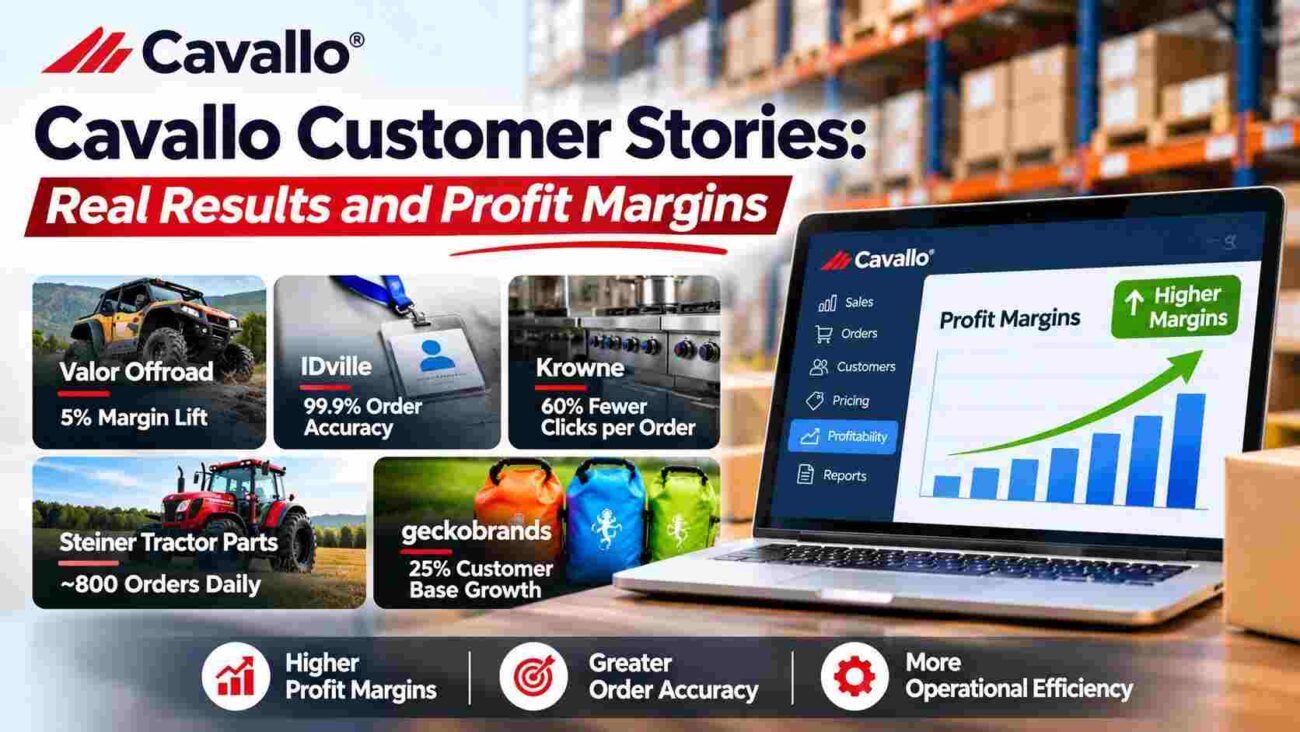
1. Valor Offroad: Responding Faster to Cost Changes
Valor Offroad distributes wheels and tires to powersports dealers. Its team relied on spreadsheet reports that could be several days old, a serious limitation when freight charges and tariffs changed quickly.
In Cavallo’s Valor Offroad case study, the company describes implementing Profit Max Platform alongside Microsoft Dynamics 365 Business Central. It reports a 5% margin lift, 68% growth from top-tier accounts, and 1.7 times growth in high-value account revenue.
The lesson is not that every distributor can match those percentages. Timely data can reveal unprofitable discounts. Ask how the margin lift was calculated.
2. IDville: More Accurate Orders and Lower Administrative Costs
IDville supplies identification products to schools, hospitals, government offices, and other organizations. Facility changes, new staff, and tax compliance work created pressure on its operations.
According to the IDville story, Cavallo SalesPad and an Avalara integration helped automate order and tax processes. IDville reports 99.9% order accuracy. Its CEO also described a 16% reduction in selling, general, and administrative spending and a 4% increase in gross profit.
Clean order data can reduce corrections and overhead. The reported gross-profit improvement is not necessarily a four-percentage-point rise in margin.
3. Krowne: Fewer Clicks to Process Each Order
Krowne manufactures stainless-steel equipment. Entering orders through its existing Dynamics GP workflow required repetitive manual steps, making higher volume difficult to handle.
On Cavallo’s SalesPad page, Krowne reports 60% fewer clicks per order after adopting SalesPad. Average customer-service call times reportedly dropped from five minutes to two. Its president also described a worker entering 140 orders in one day, compared with a previous high of 85.
These figures show efficiency, not verified net-profit growth. Buyers should also measure labor hours, corrections, and customer satisfaction.
4. Steiner Tractor Parts: Handling Volume Without Paper Bottlenecks
Steiner Tractor Parts had been using paper-based order handling alongside Microsoft Dynamics GP. As order volume increased, individual processing and slow customer lookups became obstacles.
The Steiner Tractor Parts case study describes Cavallo SalesPad workflows supporting around 800 orders per day and enabling same-day shipping. The company also uses faster reporting to identify quantity-based upselling opportunities and simplify employee onboarding.
Steiner’s experience illustrates warehouse efficiency, but capacity alone says nothing about fulfillment costs or margins.
5. geckobrands: Uncovering Missed Sales Opportunities
Outdoor-products supplier geckobrands wanted retail partners to consider products they had previously declined. Its sales team needed evidence showing which styles sold well for similar customers.
In the geckobrands case study, Cavallo describes SalesPad analytics that helped identify cross-selling opportunities across more than 1,400 customers. The supplier reports 25% customer-base growth.
This illustrates sales analytics, not margins. New sales can still be unprofitable when discounts or service costs are high.
Cavallo Customer Results at a Glance
| Business | Problem addressed | Reported result | What it demonstrates |
|---|---|---|---|
| Valor Offroad | Slow pricing and margin visibility | 5% margin lift | Reported profitability improvement |
| IDville | Manual workflows and order errors | 99.9% accuracy; 4% gross-profit increase | Accuracy and gross-profit growth |
| Krowne | Repetitive order entry | 60% fewer clicks per order | Processing efficiency |
| Steiner Tractor Parts | Paper-heavy order handling | About 800 orders daily | Scale and fulfillment capacity |
| geckobrands | Missed product opportunities | 25% customer-base growth | Customer expansion |
All results are attributed to Cavallo-published customer accounts. Time periods and measurement methods differ; the figures are not directly comparable.
What Do These Stories Really Say About Profit Margins?

The distinction between gross profit, gross margin, and revenue growth matters. Gross profit is sales minus the cost of goods sold. Gross margin expresses that amount as a percentage of revenue. Sales growth cannot offset every rise in purchasing and fulfillment costs.
Consider a distributor with $1 million in revenue and $750,000 in goods costs. Gross profit is $250,000, or a 25% gross margin. If goods costs fall to $730,000 while revenue stays unchanged, gross margin becomes 27%—an increase of two percentage points.
Cavallo’s Valor case reports a margin lift; its other case studies emphasize different outcomes. None of those results should be treated as a universal software ROI estimate. Subscription fees, integration work, training, and ongoing support should be included in any business case.
How Cavallo Fits Into a Distribution Workflow
Cavallo is not a single feature. SalesPad supports order management and related processes for compatible Microsoft Dynamics environments, while Profit Max Platform focuses on identifying margin and sales opportunities from business data. Verify the product’s ERP compatibility before buying.
For distributors selling through online stores, accurate inventory, pricing, and order synchronization also matter. Our guide to B2B and ERP integrations explains what businesses should check when connecting ecommerce platforms with systems such as Microsoft Dynamics.
A practical rollout begins with one measurable problem. For pricing, track margins on frequently sold products before and after changing discount approvals. For order processing, monitor processing time and error rates. For inventory management, compare fulfillment delays and stock discrepancies.
Document the baseline and seasonal changes to avoid attributing every improvement to software.
Internal-link opportunity: Place a link here to your existing guide on ERP integration, distribution software, or inventory management, if one genuinely helps readers understand the workflow.
How to Check a Cavallo Case Study Before Buying
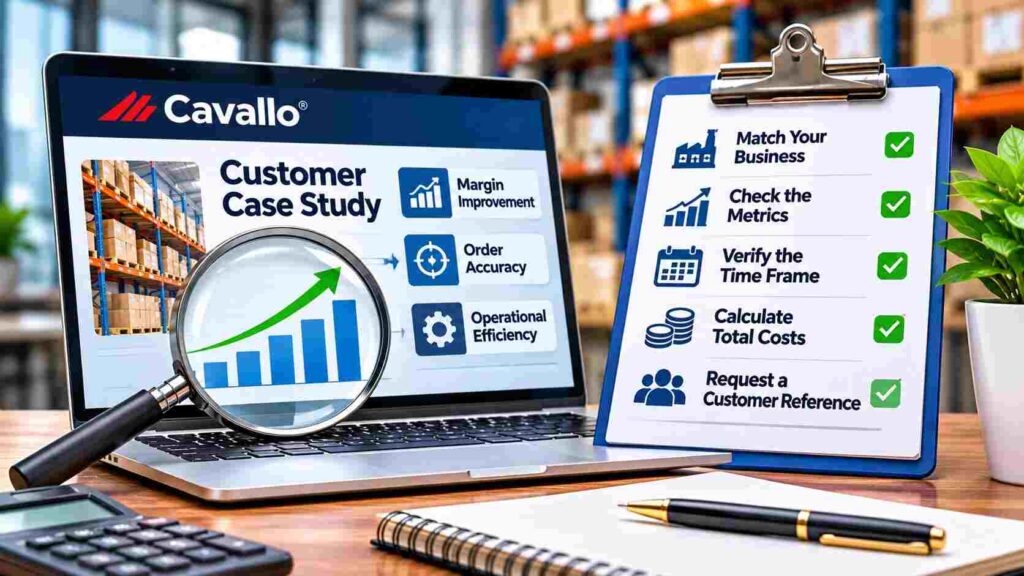
If your original search was “give me customer stories for cavallo.com”, use the examples as a starting point for specific questions rather than as promises.
- Match the business. Compare industry, order volume, sales channels, and ERP version.
- Ask for the starting point. A percentage improvement means more when the original cost, error rate, or margin is known.
- Clarify the time frame. A result achieved over several years differs from a quarter-long pilot.
- Check total costs. Include licenses, configuration, staff training, and support.
- Request a comparable reference. Ask what the customer found difficult and how long adoption took.
During demonstrations, test real pricing exceptions, inventory shortages, and problematic orders rather than relying on headline percentages.
Frequently Asked Questions
Are Cavallo customer stories about real businesses?
Yes. The published examples name companies such as Valor Offroad, IDville, Krowne, Steiner Tractor Parts, and geckobrands. Their results are company-reported, not independently audited in this article.
Does Cavallo guarantee higher profit margins?
No. Cavallo offers tools intended to improve operational visibility and decision-making, but results depend on pricing practices, data quality, implementation, and costs.
Is Cavallo only for Microsoft Dynamics users?
Some Cavallo products are designed for supported Microsoft Dynamics environments. Check the requirements for the specific product and ERP version rather than assuming every integration is available.
Which Cavallo example is most relevant to small distributors?
That depends on the bottleneck. IDville and Krowne illustrate order accuracy and efficiency; Valor focuses more directly on pricing and margins. Compare likely gains against implementation costs.
Conclusion
These Cavallo stories illustrate margin visibility, order accuracy, efficiency, capacity, and sales analysis, but only some offer direct profit figures.
Start with the original case studies, identify the outcome that matches your business, and ask for a demonstration using realistic order data. That gives you a sounder basis for a software decision than any headline percentage alone.
