
Public-source review: @Today. This is not a hands-on product test.
Your startup can have five dashboards and still miss the invoice that pays next month’s salaries. That is the problem smart software should solve: less uncertainty, fewer dropped responsibilities and more time with customers. Growth Navigate belongs in that conversation—but founders should understand what it offers before mistaking a collection of recommendations for a ready-made growth engine.
- What Growth Navigate Offers—and What It Doesn’t
- Turn Growth Navigate Research Into a Focused Buying Decision
- A Practical Growth Navigate Software-Selection Framework
- Customer Experiences: Read the Praise, Check the Evidence
- Build a 30-Day Pilot Before Making a Long-Term Commitment
- Five FAQs
- Conclusion: Buy Clarity Before You Buy Complexity
What Growth Navigate Offers—and What It Doesn’t
Growth Navigate’s current website promotes funding support, financial advisory and digital-transformation services. It describes an advisory process involving analysis, strategy, execution and continuing support. Those are advertised services, not independently verified performance results.
Separately, Growth Navigate’s startup-tools directory lists third-party products, including Asana, HubSpot Sales Hub, Zoho and Pipedrive. The reviewed pages do not establish that the business sells one proprietary, all-in-one software platform.
That distinction matters: a directory helps you discover options; the actual software vendor determines features, pricing and contractual obligations.
Turn Growth Navigate Research Into a Focused Buying Decision
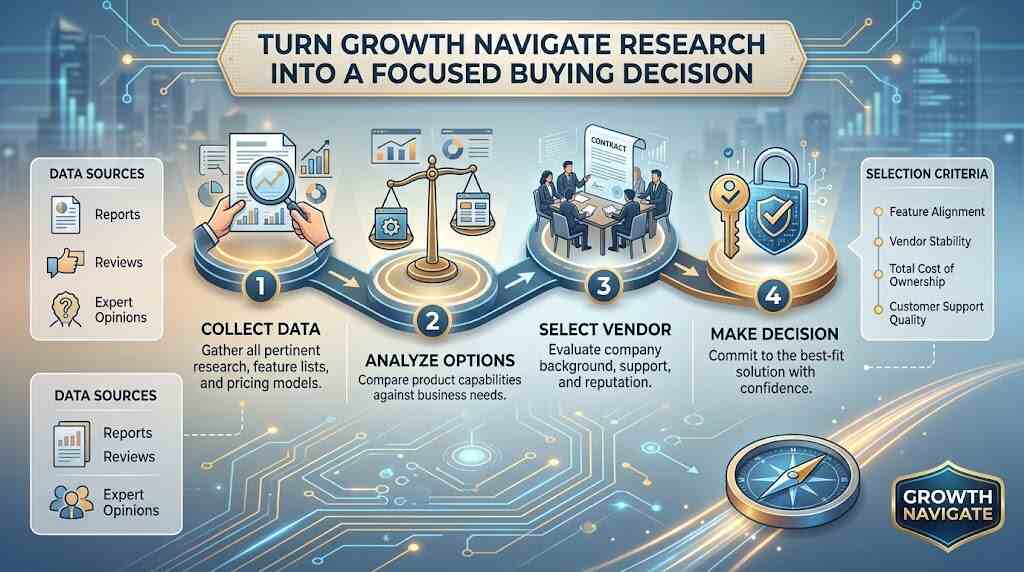
Start with the problem that keeps returning every week.
Lost inquiries? Evaluate CRM software. Late customer payments? Examine your invoicing process and cash flow management. Confusing delivery dates? Assign task ownership before buying another collaboration app.
Use Growth Navigate’s directory to build a shortlist, not to replace testing. A two-person consultancy, for example, may benefit more from scheduled invoicing and clear payment reminders than an elaborate analytics dashboard. Business growth depends on removing the bottleneck, not accumulating subscriptions.
A Practical Growth Navigate Software-Selection Framework
The following table is an original decision framework, not a vendor benchmark or a promise of results.
| Recurring problem | Software capability to test | Evidence to track |
|---|---|---|
| Sales inquiries get lost | Lead ownership and next-action reminders | Response time; unassigned inquiries |
| Payments arrive late | Invoicing and receivables tracking | Overdue balances; collection time |
| Projects drift | Shared deadlines and task accountability | Missed milestones; overdue tasks |
| Spending becomes unclear | Categorized transactions and cash forecasting | Forecast accuracy; unexpected expenses |
Test these capabilities using real workflows and appropriately protected data. Ask someone who will use the system daily to complete an ordinary task without the salesperson guiding every click.
Customer Experiences: Read the Praise, Check the Evidence
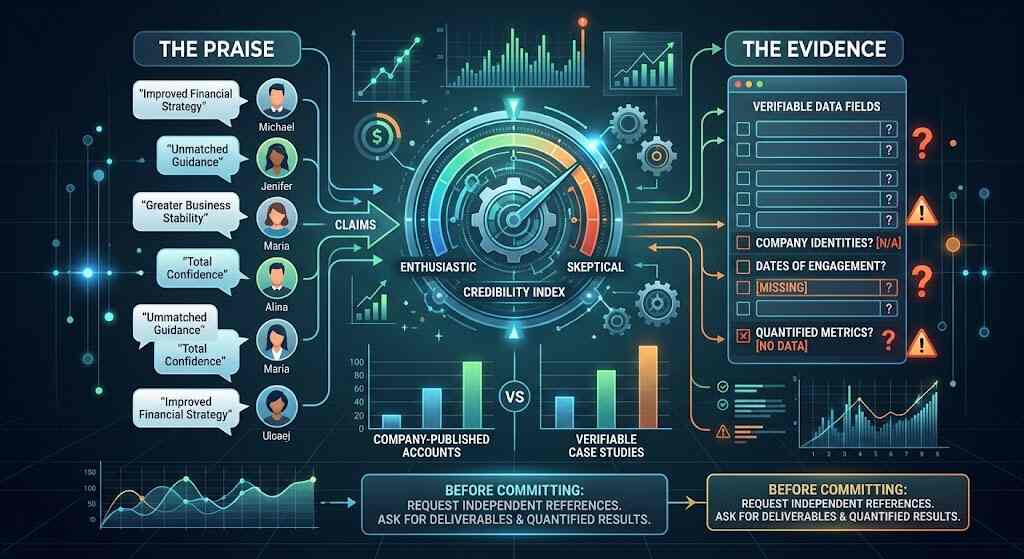
Growth Navigate publishes testimonials attributed to Michael Soveign, Jenifer Cohen and Maria Goncavales. Their statements describe improvements in financial strategy, guidance and business stability. However, the reviewed homepage does not attach company identities, dates or quantified before-and-after outcomes to those testimonials.
They are company-published accounts, not independently verified case studies in this review. Before paying for support, request a reference from a comparable business. Ask what was delivered, who implemented it and whether the improvement lasted.
Build a 30-Day Pilot Before Making a Long-Term Commitment
Engaging Growth Navigate should begin with a written scope: advice, implementation or both. Clarify deliverables, fees, responsibilities and what happens if the recommended tool does not fit.
For an illustrative subscription startup, connect the buying journey operationally: capture an inquiry, assign it in CRM software, schedule a human follow-up, then use permission-based marketing automation where appropriate. Review lead quality, not just email opens.
For cash flow management, reconcile records and compare expected receipts with actual collections. Financial planning becomes more useful when somebody owns the updates.
Include migration time, training, integrations and exit costs in the decision. Check data-export options before uploading important records. During the pilot, record time spent on the workflow and mistakes that still occur; those observations provide a better buying rationale than a long feature checklist. An attractive introductory subscription can still be a poor fit if the team cannot maintain it.
Five FAQs
1. Is Growth Navigate a single software application?
The reviewed public pages describe advisory services and a third-party tools directory, rather than documenting one proprietary application.
2. Which tools does Growth Navigate list?
Examples include Asana for work management and HubSpot Sales Hub, Zoho and Pipedrive in its sales section. Verify current capabilities directly.
3. Is Growth Navigate free to use?
Its directory can be browsed publicly. Software subscriptions and advisory engagements are separate decisions; request current terms rather than assuming everything is included.
4. Can software guarantee startup funding?
No. While accurate record keeping can help in preparation, funding for startups is dependent on elements such as investor fit and business performance.
5. How should founders evaluate Growth Navigate recommendations?
Ask for a clear business objective, implementation owner and measurable pilot outcome. Compare the total cost with the problem being solved.
Conclusion: Buy Clarity Before You Buy Complexity
Growth Navigate can help founders discover options, but discovery is only the beginning. Sustainable business growth comes from tools your team understands, reliable records and customer problems addressed consistently. Let financial planning be the guide to the budget, let a little experiment prove the promises, and then let expansion take place. The best software does not make your startup look sophisticated. It makes the business easier to run—and gives you more attention to spend on the people it serves.
